5 Reasons One-Man Cattle Outfits Are Retiring Chute Day — Without Changing What's in the Jug
Tags, pour-ons, dust bags — every one of them assumes you can catch her first. A 12V feed-line fogger runs the concentrate you already buy and covers the bunch while they eat. No gather. No chute. No second man.


Every Treatment You Own Assumes There Are Two of You
If you run cattle with no help and no large-animal vet inside an hour — and you've ever driven back from checking the herd telling yourself you should've gotten out there sooner — read this part slowly.
Your fly program isn't failing because of you. Not your schedule. Not your work ethic. Not the brand you picked. The chemistry in that jug does its job — it always did.
The failure is in what every one of those products quietly demands before the chemistry ever touches an animal:
Different jugs. Same gate. Somebody has to catch her first — and on your place, every somebody is you.
So the program most solo operators actually run isn't the one printed on the label. It's gather when there's time and help, treat what you can, and hope the stretch in between doesn't cost too much. Nobody says that out loud, because it sounds like admitting you can't manage your own place. It isn't. It's what a two-man format does to one man. The tell is already printed on your shelf — every one of those jugs carries a re-treat interval it quietly assumes you can keep. That stretch in between has a name and a price tag. Both are next.
| What chute day asks | What a feed-line pass asks |
|---|---|
| Gather, sort, pen the bunch | Drive a line you already drive |
| A second man, minimum | One seat, one switch |
| A squeeze or a chute | None |
| A full day, planned around weather and work | Ten minutes inside a chore that already exists |
| Re-treat whenever help lines up again | Whatever cadence the label permits |

That Stretch In Between Has a Dollar Figure — and It's Yours to Calculate
Fly pressure never sends a bill in July. Calves bunched in a corner fighting flies instead of grazing don't look like money walking off — not day to day. It shows up once a year, in October, on the scale ticket. And by then it's already gone.
Set our machine aside for a minute. This is just what the extension research says fly pressure costs, and the number is the same whether you buy anything or not:
University of Nebraska Extension puts horn flies at over $1 billion a year in losses across U.S. producers, sets the economic-injury threshold at roughly 200 flies per animal, and reports calf weaning weights running 10–20 pounds heavier when fly pressure on the cows is controlled. Their figures, not ours — go read them.
Run that on your own herd, at your own sale barn's prices, and set the answer against one machine that works every season after this one. We're not going to tell you what you'll get back — your herd, your climate, your fly pressure and your management decide that. We're telling you what the other side of the ledger looks like, and letting you hold the calculator.

The Frequency Gap — Why Every-Few-Days Beats a Stronger Jug
Here's the question a smart skeptic asks first: if the pour-on doesn't hold, why on earth would a mist do better?
Honest answer: it wouldn't — if you applied it on the same calendar.
Pull any fly-control label off your own shelf and read the re-treatment interval printed on it. Most say every couple of weeks. Now run a 150-day fly season against that line: the label is asking a one-man outfit for something like ten full gathering days a summer. Nobody working alone hits ten. Most are proud to hit three.
That's the whole trick — and it's why this page will spend zero time telling you our mist is stronger than your pour-on. It isn't. It's just there every few days.
It Lands Like Weather, Not Like Handling
This is the one everybody wonders and nobody prints: won't they just run off?
Think about what actually moves a cow at the bunk — pressure she can read. A jet of cold water hitting hide. A machine that sounds like sorting day. A man on foot closing distance. Her whole life has taught her what handling feels like, and she leaves before it starts.
A fogger does none of that.
It breaks the liquid into a fine mist that drifts and settles over the group — no stream, no slap, no noise that means anything to an animal with her head down in feed. Nothing about the pass reads as handling, so nothing about the pass asks her to leave.
When you run your first pass, don't watch the mist. Watch the tails. Idle tails on a fed bunch are the entire story of this machine.
Same Jug. Two Clamps. Ten Minutes.
This isn't a chemical and it isn't a program. It's the delivery half — and it's built to bolt onto the operation you already run, not replace it:
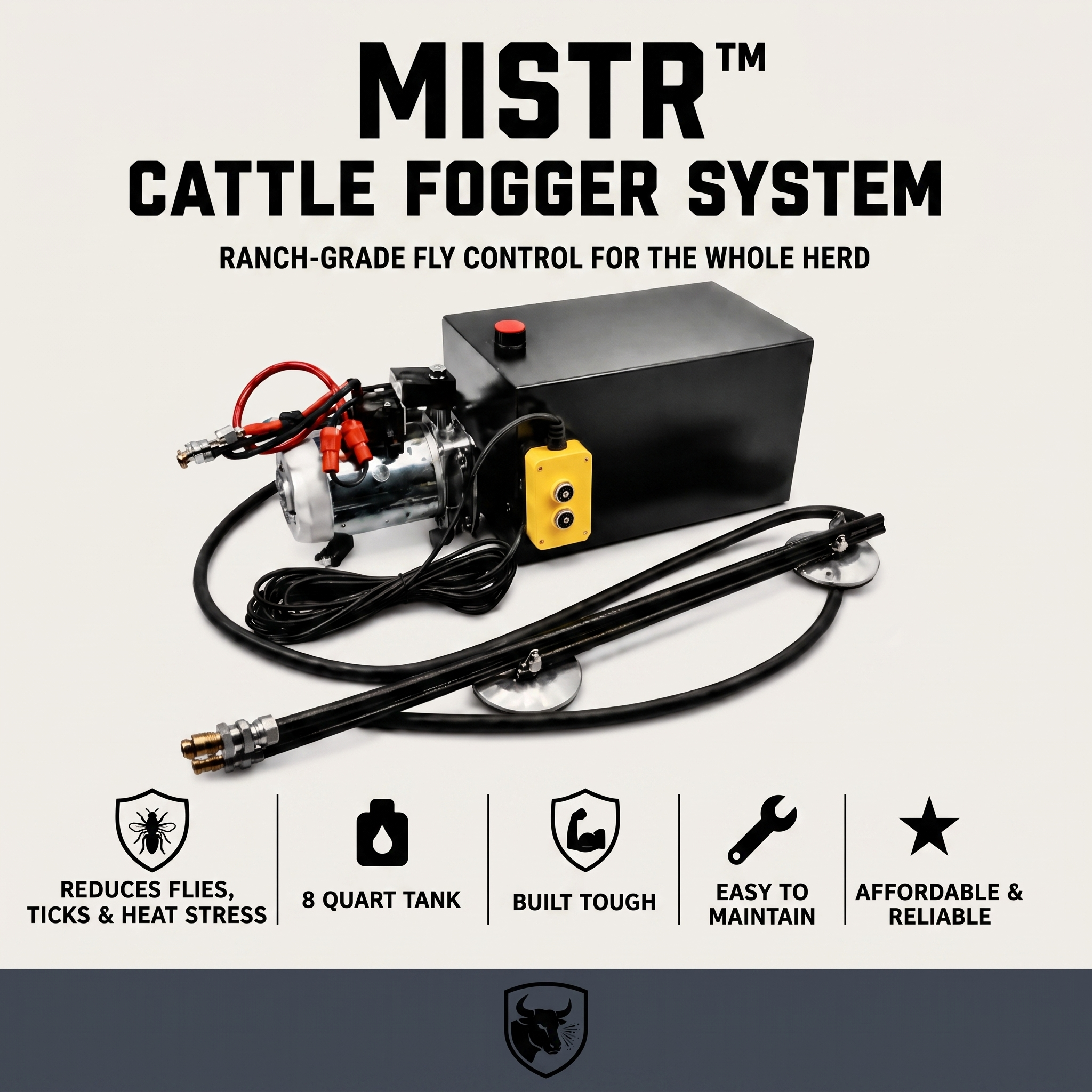
MISTR™ Feed-Line Fogger System
MISTR is a delivery system, not a treatment. The results in your pasture come from the concentrate you choose, the label you follow, and the frequency you can finally hold. What MISTR changes is the cost of a treatment — from a gathered day down to a driven pass. That's the only thing it claims to change.
Get MISTR™ — In-Season Price
Run It on Your Own Herd.
Let the Month Decide.
You've spent enough summers blaming yourself for a format built for two men. Here's the other way to settle it.
Every order carries the 30-Day Working Trial:
You keep working while you decide. The risk sits on our side of the fence — that's what the trial is for.
Free U.S. shipping · Full refund window runs 30 days from delivery
What We Won't Promise You
We're not going to promise you heavier calves, a clean August, or a better October check. Anybody selling a fogger who promises outcomes is selling past the machine — the results are the product you put in the tank and the label you follow. Not ours to claim.
What we'll stand behind is narrower and harder: the hardware, and the fact that one man can run it inside a chore he already does. That claim we'll put money on — it's exactly what the 30 days are for.
And you won't find a review wall on this page yet, because MISTR is new and we won't print reviews that don't exist. When real ones come in, they'll go right here — names, warts and all.
Straight Answers
Will one pass really reach the belly and the legs?
Depends on wind, ground speed, nozzle setting and how the bunch is standing — anybody who tells you otherwise is selling. What a fogger does is put a drifting mist over and around the group instead of a stream at one head, and a mist settles where a tag never reaches: the underline, the legs, the ground they're standing on. In calm air figure roughly 10–15 feet of useful drift; in a stiff breeze, work downwind of the bunch and slow down. A still morning at the bunk is your best pass of the week.
Will it run the concentrate I already buy?
That's the point of it. Fill it with any fly-control product labeled for direct spray or mist application to cattle, and follow that product's label — rates, intervals, restrictions, all of it. MISTR changes the delivery, not the rules on the jug.
How long does a tank last?
Honest answer: it depends on your nozzle setting and how fast you drive, and we'd rather not guess in print. The Frequency Planner that ships with the unit includes a fill log — after two passes you'll know your own number, which is the only one that matters.
Is it hard to set up?
Two clamps and a quick-connect. The cables go on any standard 12V top-post battery, the hose snaps to the coupler, and the switch does the rest. No wiring job, no fuse box, no shop visit. Set it in a truck bed or strap it in a UTV — it isn't married to either.
Who is MISTR? I've never heard the name.
Fair — the name is new. MISTR is a direct operation: we source the unit, sell it ourselves with no dealer layer, and stand behind it with the 30-day working trial. We don't have a decade of reviews to show you yet, and we won't invent one. What we have is a machine you can put to work on your own herd for a month before the money settles. That trade — proof for time — is the honest version of trust for a new name, and we're comfortable making it.
This is the year it finally gets applied often enough.